



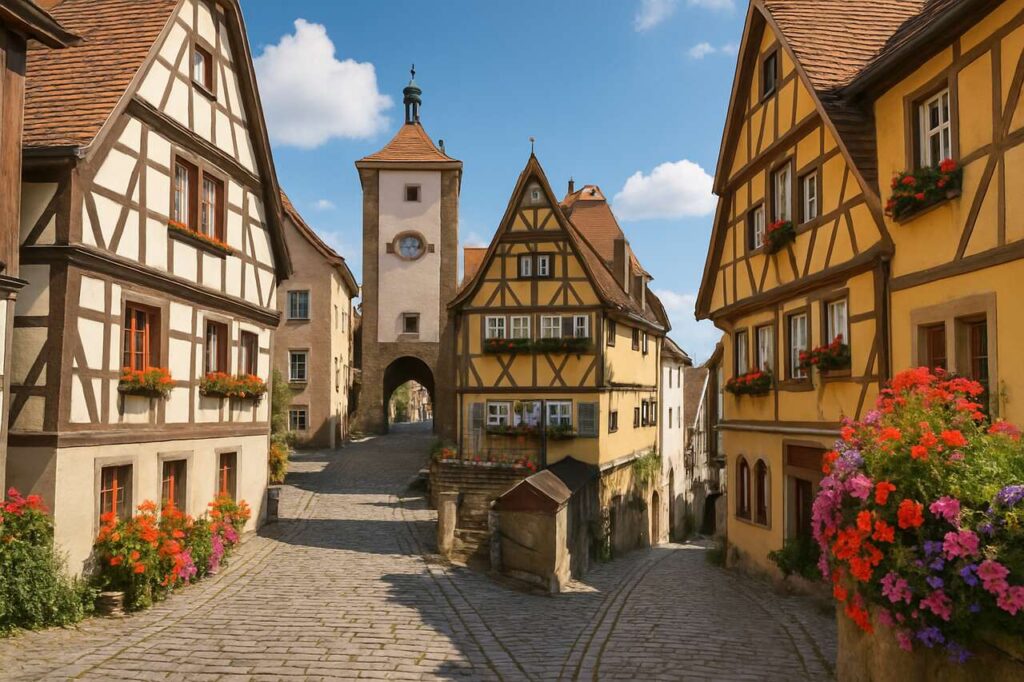
Germany’s small towns preserve centuries of architectural heritage and natural splendour, offering visitors an escape into landscapes where cobbled streets wind past timber-framed houses and medieval fortifications stand guard over valleys and rivers. These destinations provide authentic encounters with regional culture, far removed from the crowded itineraries of major cities.
Rothenburg ob der Tauber and the Romantic Road
A medieval jewel frozen in time
Rothenburg ob der Tauber represents one of Bavaria’s most celebrated historic settlements, positioned along the famous Romantic Road tourist route. The town’s remarkably preserved medieval walls encircle a centre where half-timbered buildings lean towards narrow lanes, creating an atmosphere that transports visitors back several centuries. The fortifications stretch for approximately 2.5 kilometres, offering elevated walkways from which to survey the surrounding Tauber valley.
Key attractions within Rothenburg include:
- The Market Square with its Renaissance town hall and arcade
- St. Jakob’s Church housing the Holy Blood altarpiece
- The Medieval Crime Museum displaying historical legal instruments
- Plönlein, the most photographed corner where two streets converge
Accessibility and seasonal considerations
Reaching Rothenburg from Frankfurt requires approximately 2.5 hours by coach or under an hour by private vehicle. The town experiences peak visitation during December, when its Christmas market transforms the squares into a festive wonderland. Artisan workshops throughout the old town produce traditional crafts year-round, from hand-painted ornaments to intricate wooden toys.
Beyond Rothenburg’s medieval charm, Germany’s small towns extend into regions where natural landscapes provide equally compelling backdrops for exploration.
Füssen and its Alpine landscapes
Gateway to royal castles
Füssen occupies a strategic position in southern Bavaria, where the Alps rise dramatically from the foothills. This town serves as the primary base for visiting Neuschwanstein Castle, King Ludwig II’s fairy-tale fortress perched on a rugged cliff. The historic centre of Füssen itself rewards exploration, with its baroque monastery of St. Mang and colourful facades lining the Lech River.
| Attraction | Distance from Füssen | Typical visit duration |
|---|---|---|
| Neuschwanstein Castle | 5 kilometres | 3-4 hours |
| Hohenschwangau Castle | 4 kilometres | 2-3 hours |
| Forggensee Lake | Adjacent | Half day |
Mountain trails and cultural heritage
The surrounding landscape offers extensive hiking opportunities through Alpine meadows and forests, with trails suitable for various fitness levels. Forggensee, Bavaria’s fifth-largest lake, provides opportunities for sailing and swimming during summer months. The town’s musical heritage remains evident in its violin-making tradition, which dates back centuries and continues in specialist workshops.
From Alpine heights, the journey continues to river valleys where viticulture shapes both landscape and local economy.
Cochem, jewel of the Moselle valley
Riverside charm beneath castle walls
Cochem rises in terraced layers from the Moselle River’s banks, crowned by the Reichsburg Castle whose turrets dominate the skyline. The town’s historic centre features half-timbered houses painted in vibrant colours, their facades creating a picturesque waterfront that has inspired countless photographs. The castle, reconstructed in neo-Gothic style during the 19th century, offers guided tours revealing medieval living conditions and panoramic valley views.
Wine culture and river exploration
The Moselle valley’s steep slopes support vineyards producing distinctive white wines, particularly Riesling varieties that thrive in the region’s microclimate. Cochem’s wine cellars and taverns provide tasting opportunities, whilst river cruises allow visitors to appreciate the valley’s beauty from the water. Neighbouring villages such as Beilstein and Traben-Trarbach lie within easy reach, each offering additional architectural treasures and viticultural traditions.
Whilst Cochem exemplifies river valley settlements, other German towns preserve medieval character in different geographical contexts.
Monschau, an enchanting medieval village
Eifel region’s hidden treasure
Monschau nestles within the Eifel National Park, where the Rur River carves through wooded hills near the Belgian border. The village’s narrow streets climb steeply between slate-roofed houses, many dating from the 17th and 18th centuries when textile manufacturing brought prosperity. The Red House, a former cloth merchant’s residence, now operates as a museum showcasing period furnishings and the town’s industrial heritage.
Monschau’s appeal includes:
- The medieval castle ruins overlooking the valley
- Traditional mustard mill producing artisan condiments
- Glass-blowing workshops demonstrating centuries-old techniques
- Hiking trails through surrounding nature reserve
Seasonal transformations
Winter transforms Monschau into a particularly atmospheric destination, when Christmas markets occupy the historic squares and snow often blankets the surrounding hills. The village’s compact size makes exploration on foot both practical and rewarding, with numerous cafés and restaurants serving regional Eifel cuisine.
Germany’s eastern regions harbour equally impressive small towns, where historical preservation has maintained architectural integrity across centuries.
Görlitz, an unspoilt border town
Architectural diversity on the Neisse
Görlitz occupies both banks of the Neisse River, forming Germany’s easternmost town on the Polish frontier. The settlement boasts over 4,000 protected buildings spanning Gothic, Renaissance, Baroque and Art Nouveau periods, creating an architectural anthology rarely matched elsewhere. This preservation resulted partly from the town’s escape from significant wartime destruction, leaving its historic fabric largely intact.
Film location and cultural crossroads
The town’s pristine historic centre has attracted numerous film productions, serving as a backdrop for period dramas requiring authentic European settings. Görlitz’s Untermarkt square exemplifies this architectural richness, surrounded by buildings from different eras that somehow achieve visual harmony. The town’s position on the border facilitates easy exploration of Polish Zgorzelec across the river, effectively creating a binational urban area.
| Architectural period | Notable examples | Characteristics |
|---|---|---|
| Gothic | Church of St. Peter and Paul | Pointed arches, ribbed vaults |
| Renaissance | Schönhof building | Symmetrical facades, decorative gables |
| Art Nouveau | Kaufhaus Görlitz | Ornamental ironwork, curved lines |
From border regions, the journey concludes in central Germany, where UNESCO recognition acknowledges exceptional historical significance.
Quedlinburg, historical Saxony’s treasure
UNESCO World Heritage distinction
Quedlinburg preserves one of Europe’s finest ensembles of half-timbered architecture, with over 2,000 timber-framed houses spanning six centuries. The town’s UNESCO designation recognises both this architectural wealth and its historical importance as a medieval royal residence. The collegiate church and castle complex dominate the skyline, containing treasures including a 10th-century crypt and valuable medieval manuscripts.
Living history and contemporary culture
Despite its historical character, Quedlinburg maintains a vibrant contemporary community rather than functioning merely as an open-air museum. Local businesses occupy historic buildings, whilst cultural events throughout the year animate the squares and courtyards. The town’s compact layout encourages exploration on foot, revealing unexpected architectural details and quiet corners that reward unhurried discovery.
These eight destinations demonstrate Germany’s remarkable preservation of small-town heritage, where architectural treasures and natural settings combine to create memorable experiences. Each location offers distinct character shaped by regional geography, historical development and cultural traditions. Accessibility from major cities makes these towns practical for day excursions or extended stays, providing alternatives to conventional tourist circuits. The combination of preserved medieval centres, surrounding landscapes and authentic local culture ensures these small towns continue attracting visitors seeking substance beyond superficial sightseeing. Planning flexible itineraries allows spontaneous discoveries that often become journey highlights, whilst respecting seasonal variations helps optimise each destination’s particular appeal.