



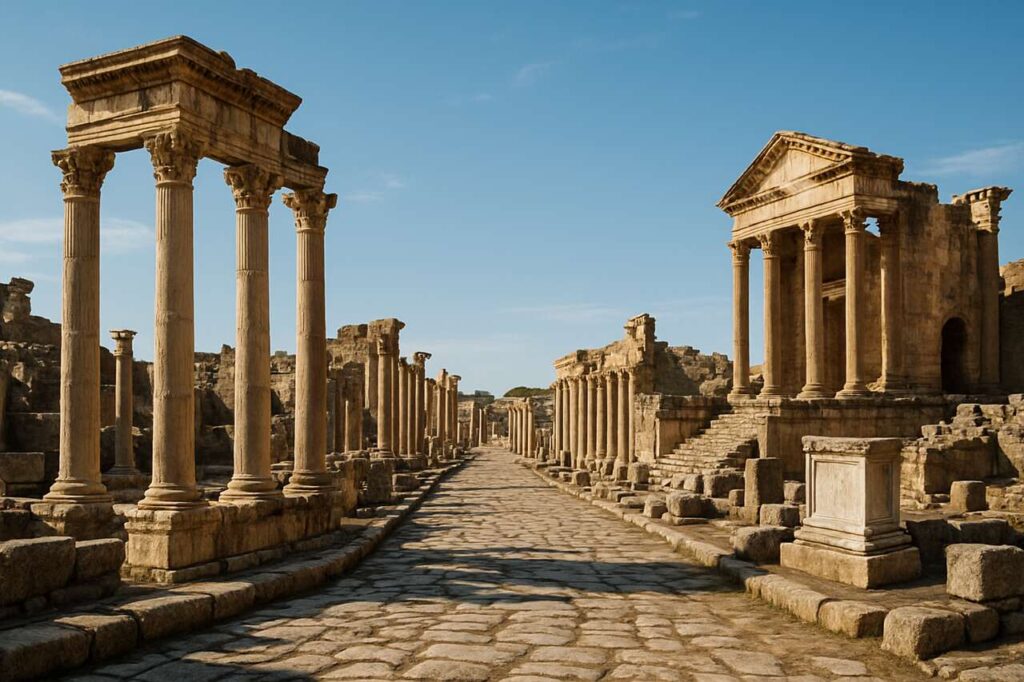
The ancient Roman civilisation left an indelible mark across three continents, creating urban centres that showcased architectural brilliance, administrative sophistication and cultural richness. These cities, once bustling with merchants, senators and citizens, now stand as remarkable testimonies to one of history’s most influential empires. From the ash-preserved streets of Pompeii to the monumental ruins scattered across the Mediterranean, each site offers visitors a unique window into daily life, commerce and governance during antiquity. Exploring these archaeological wonders allows modern travellers to walk in the footsteps of Romans, experiencing the grandeur and complexity of their urban planning, engineering prowess and artistic achievements.
Discovering Pompeii, the city frozen in time
The catastrophic eruption that preserved history
Pompeii’s fate was sealed in 79 AD when Mount Vesuvius erupted with devastating force, burying the thriving city beneath metres of volcanic ash and pumice. This tragic event, whilst claiming thousands of lives, inadvertently created one of the world’s most extraordinary archaeological sites. The volcanic material acted as a natural preservative, protecting buildings, frescoes, mosaics and even organic materials from decay. Today, visitors can witness remarkably intact structures that provide unparalleled insights into Roman urban life, from luxurious villas to modest shops and public bathhouses.
Walking through ancient streets and homes
The excavated areas of Pompeii reveal a sophisticated city layout with:
- Paved streets featuring raised pedestrian crossings
- The Forum, serving as the commercial and political centre
- Elaborate bath complexes with advanced heating systems
- Theatres accommodating thousands of spectators
- Bakeries with original millstones and ovens
The House of the Faun and the Villa of the Mysteries showcase stunning frescoes depicting mythological scenes, whilst plaster casts of victims offer poignant reminders of the human tragedy. The site’s preservation extends to graffiti on walls, revealing everything from political slogans to declarations of love, providing an intimate glimpse into the thoughts and concerns of ordinary Pompeians.
Beyond Pompeii’s frozen streets, another significant Roman settlement awaited rediscovery along the Tyrrhenian coast.
Journey to Ostia, rome’s ancient port
Gateway to maritime commerce
Ostia Antica served as Rome’s primary harbour for centuries, facilitating the import of grain, wine, olive oil and luxury goods from across the Mediterranean. Located approximately 30 kilometres from modern Rome, this archaeological site offers visitors a less crowded alternative to Pompeii whilst maintaining exceptional preservation. The city’s strategic importance meant continuous development, resulting in a diverse architectural landscape spanning several centuries of Roman history.
Exploring the commercial heart of the empire
Ostia’s excavations reveal the intricate workings of Roman commerce through:
- The Piazzale delle Corporazioni, featuring mosaics indicating different trading companies
- Multi-storey apartment buildings (insulae) housing the working population
- The impressive theatre, still used for summer performances
- Numerous taverns (thermopolia) with intact serving counters
- Public latrines demonstrating Roman sanitation engineering
The Neptune Baths display magnificent black-and-white mosaics, whilst the Capitolium temple dominates the forum area. Unlike Pompeii’s sudden destruction, Ostia declined gradually as the harbour silted up, allowing residents to remove valuable materials but leaving substantial structures intact. The site’s excellent preservation of everyday buildings provides invaluable information about ordinary Roman life rather than solely focusing on elite residences.
From this commercial hub, attention naturally turns to the empire’s beating heart itself.
Visit the immortal Rome, heart of the empire
The eternal city’s monumental legacy
Rome remains a living museum where ancient ruins coexist with modern urban life. The city’s archaeological sites span over a millennium of development, from the legendary founding to the empire’s transformation. The Colosseum, perhaps Rome’s most iconic structure, could accommodate 50,000 spectators for gladiatorial contests and public spectacles. Its sophisticated design included underground chambers, mechanical lifts and a complex system for managing crowds.
Essential Roman sites within the city
| Monument | Period | Significance |
|---|---|---|
| Roman Forum | 8th century BC onwards | Political and commercial centre |
| Pantheon | 126 AD | Architectural masterpiece with intact dome |
| Baths of Caracalla | 216 AD | Massive public bathing complex |
| Circus Maximus | 6th century BC | Chariot racing venue for 150,000 spectators |
The Palatine Hill offers panoramic views whilst showcasing imperial palace ruins, and the Arch of Constantine commemorates military victories through detailed reliefs. Walking through these sites requires imagination to reconstruct the marble-clad buildings, painted statues and bustling crowds that once filled these spaces. Modern Rome’s layered history means visitors can descend beneath medieval churches to discover earlier Roman structures, revealing the city’s continuous occupation.
Whilst Rome dominated the Italian peninsula, another site nearby offers a different perspective on Roman urban life.
Exploring Herculaneum, unexpected archaeological treasure
A wealthier neighbour to Pompeii
Herculaneum, also destroyed by Vesuvius in 79 AD, presents a more intimate archaeological experience than its famous neighbour. This smaller settlement catered to Rome’s wealthy elite, who built elaborate seaside villas to escape summer heat. The different burial process, involving pyroclastic flows rather than ash fall, resulted in superior preservation of organic materials including wooden structures, foodstuffs and even papyrus scrolls.
Remarkable preservation details
Herculaneum’s excavations have revealed:
- Two-storey buildings with intact wooden balconies and doors
- Carbonised furniture, including beds and cupboards
- Preserved foodstuffs in storage jars
- The Villa of the Papyri, containing a philosophical library
- Boat chambers where residents sought refuge, with skeletal remains
The House of Neptune and Amphitrite features a stunning glass mosaic that has retained its vibrant colours, whilst the Samnite House demonstrates earlier Italic architectural influences. Herculaneum’s compact size makes it more manageable for visitors, yet the quality of preservation often surpasses Pompeii. The site continues to yield discoveries, with significant portions remaining unexcavated beneath the modern town of Ercolano.
Moving beyond Italy’s borders, Roman influence extended throughout the Mediterranean, creating impressive urban centres in conquered territories.
The grandeur of Carthage, legendary rival of Rome
From Punic power to Roman province
Carthage’s history encompasses two distinct civilisations: the Phoenician trading empire that challenged Rome during the Punic Wars, and the subsequently rebuilt Roman city that became North Africa’s administrative capital. Located near modern Tunis, the archaeological site combines remains from both periods, though Roman structures dominate the visible ruins. After Scipio Africanus destroyed Punic Carthage in 146 BC, Julius Caesar ordered reconstruction, creating a city that rivalled Rome itself in prosperity and architectural splendour.
Roman Carthage’s monumental remains
Key sites within the archaeological park include:
- The Antonine Baths, once the largest outside Rome
- A Roman theatre and amphitheatre complex
- The Tophet, a Punic religious sanctuary
- Extensive residential areas with mosaic floors
- The circular Punic harbour installations
The Antonine Baths particularly impress visitors with their scale, featuring underground heating systems and elaborate decoration programmes. The site’s coastal location provided strategic advantages whilst creating a pleasant environment for the Roman elite. Museums display recovered mosaics, statuary and everyday objects that illustrate the city’s wealth and cultural sophistication. Carthage’s dual heritage makes it unique amongst Roman sites, offering insights into how conquered territories were absorbed and transformed within the empire.
Roman expansion reached far into the Iberian Peninsula, where another remarkable city awaited development.
Évora, the Roman pearl of Portugal
A provincial capital in Lusitania
Évora, known as Ebora Cerealis in Roman times, served as an important administrative centre in the province of Lusitania. The modern Portuguese city has seamlessly integrated Roman remains within its medieval urban fabric, creating a unique palimpsest of historical periods. The site’s significance earned it UNESCO World Heritage status, recognising both Roman and later contributions to its architectural heritage.
Roman monuments within the medieval city
The Temple of Diana, despite its traditional name, likely honoured Emperor Augustus rather than the hunting goddess. This remarkably preserved structure features:
- Fourteen Corinthian columns, some with original capitals
- A raised podium typical of Roman temple architecture
- Granite construction using local materials
- Medieval modifications that ironically aided preservation
Beyond the temple, visitors can explore sections of the Roman walls incorporated into later fortifications, and the remains of Roman baths beneath the town hall. The archaeological museum houses mosaics, inscriptions and everyday objects recovered from excavations. Évora demonstrates how Roman urbanism influenced subsequent development, with the forum area remaining the city’s central square throughout centuries of occupation. The site’s integration within a living city offers a different experience from isolated archaeological parks, showing continuity of urban life from antiquity to the present day.
These seven cities represent diverse aspects of Roman civilisation, from catastrophically preserved snapshots of daily life to continuously inhabited urban centres. Each site offers unique insights into Roman engineering, artistic achievement and social organisation, whilst collectively demonstrating the empire’s vast geographical reach and cultural influence. Visiting these locations allows travellers to appreciate not only monumental architecture but also the sophisticated urban planning, commercial networks and cultural exchanges that characterised Roman society. The preservation of these sites enables modern audiences to connect directly with ancient experiences, walking streets designed two millennia ago and contemplating the enduring legacy of Roman civilisation across Europe, North Africa and beyond.